St. Andrew’s Episcopal Church
What Is an Episcopal Church?
Ancient prayers. A wide welcome. A table set by grace. There is room here for your questions, your story, and you.
A church with a long memory and an open door
The Episcopal Church is a Christian church. We follow Jesus Christ, whose life, death, and resurrection are good news for the whole world. We trust the God who made you, knows you, and loves you. We believe that this God is still at work: forgiving sins, healing wounds, making peace, and calling ordinary people into a new way of life.1
At St. Andrew’s, that begins with a chair and a welcome. You do not need to arrive with the right words. You do not need to hide your doubts. You do not need to pretend that your life is tidier than it is. Come and see.
A big tent
The Episcopal Church in Alabama describes itself as “A Place for Everyone.” It invites people into a faith rooted in God’s unconditional love and into a community that celebrates differences instead of letting them divide us.2
That is the kind of church we mean to be in Montevallo. Your skin color is not a barrier. Your politics are not an entrance exam. Your sexual orientation or gender identity is not a reason to stand outside. Your age, income, doubts, disabilities, church history, and lack of church history are not disqualifications. There is no velvet rope around the grace of God.
Women are welcome in every part of the church’s life and leadership: as bishops, priests, deacons, wardens, and vestry members. St. Andrew’s made room early. In 1969, only weeks after the diocese first allowed it, the parish elected Vivian Irene Roe to the vestry, the elected lay council that helps lead a parish. By the available records, she was the first woman elected to a vestry in the Episcopal Diocese of Alabama.3 The deeper reason is not novelty but baptism. As Paul writes, “[…] there is no longer Jew or Greek; […] there is no longer male and female; for all of you are one in Christ Jesus.”4
This does not mean that everyone agrees about everything. It means that we gather around Jesus before we gather around our opinions. It means that every person bears the dignity God gives them. In baptism, Episcopalians promise to seek and serve Christ in all persons, love our neighbors, strive for justice and peace, and respect the dignity of every human being.5
The Episcopal Diocese of Alabama speaks plainly about the work still before us. Its racial-healing ministry names racism as a sin in the history of nation, state, and church, and calls Episcopalians to learn, heal, pursue justice, and build a community where every person is seen, heard, and welcomed.6
Rooted in the Anglican tradition
St. Andrew’s is part of the Episcopal Diocese of Alabama. The diocese is made up of 87 faith communities and six college ministries across Alabama.2 The Episcopal Church is the American member church of the worldwide Anglican Communion, a global Christian family with roots in the Church of England.1
Anglican Christianity grew out of the church in England. Its story reaches back through Celtic Christianity and the mission of Augustine of Canterbury in the sixth century, through the English Reformation in the sixteenth century, and into a worldwide communion of self-governing churches held together by shared prayer and relationship.7
The word Episcopal comes from a word for bishop. Our church is led by bishops, with priests, deacons, and laypeople sharing the work. Anglican tradition is sometimes called a via media, a middle way. It holds together ancient creeds and sacraments, the Reformation’s call to renewal, and a habit of reasoning together from Scripture, tradition, and reason.7
A small American revolution
Before the American Revolution, Anglican parishes in the colonies belonged to the Church of England and came under the direction of the Bishop of London. The Revolution made that arrangement impossible. Many clergy left for Canada or other parts of the British Empire, while laypeople kept parish churches alive.8
After independence, Anglicans in the new United States organized an autonomous church. The first American bishop, Samuel Seabury, was consecrated by Scottish bishops in Aberdeen in 1784. By 1789, clergy and lay representatives had gathered in Philadelphia for a General Convention. The Episcopal Church was taking shape: still Anglican, fully American, and connected to a wider family across borders.7
That history still leaves its mark. Episcopalians are at home with old prayers and new questions. We do not believe faith is made stronger by fear. We believe truth can bear patient conversation.
What we believe
The center is Jesus. Episcopalians confess the historic Christian faith: one God, Father, Son, and Holy Spirit; Jesus Christ crucified and risen; the forgiveness of sins; the resurrection of the dead; and the life of the world to come.1
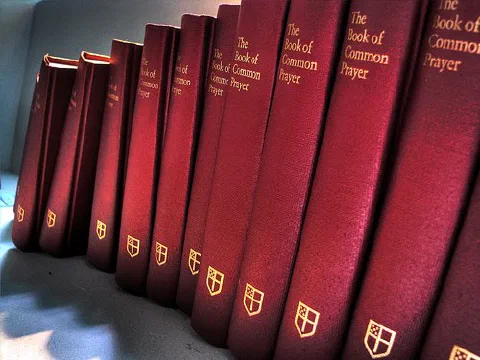
The Bible is read aloud whenever we gather for Sunday worship. The Book of Common Prayer gives us a common pattern for prayer, baptism, Communion, marriage, burial, morning prayer, evening prayer, and the ordinary days in between.5 You do not have to master it before you arrive. The words will carry you until they become familiar.
The prayer book also keeps us between the lines. Week by week, it gives us words shared with a much larger church. We are drawn into communion through a common language, just as we are drawn into communion through bread and wine. No single personality gets to dominate the room. The prayers keep turning our eyes toward God.
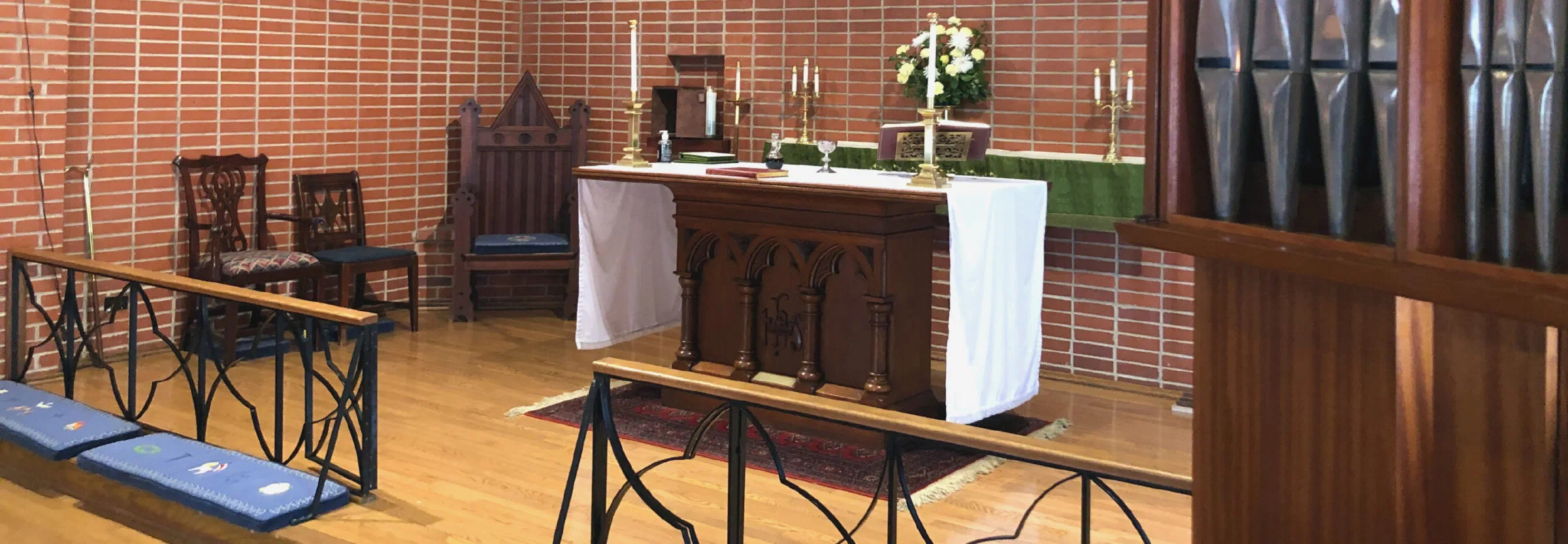
The Holy Eucharist, also called Holy Communion, is the heart of our Sunday worship. We hear Scripture, pray for the church and the world, share bread and wine, and are sent back into daily life to love and serve the Lord. At St. Andrew’s, the Holy Eucharist, Rite Two, is celebrated every Sunday at 11:30 a.m. If you have been baptized in any Christian tradition, you are welcome to receive Communion.9 If you have not been baptized, come forward for a blessing. The welcome is still for you.
Wonderful, wonderful Camp McDowell
The Episcopal Church in Alabama has a backyard. Camp McDowell is a year-round diocesan ministry near Bankhead National Forest in Winston County. Its mission is to show “the way the world could be” through worship, learning, rest, and play in the beauty of what camp calls “God’s Backyard.”10
Camp McDowell began in 1923. Today its more than 1,100 acres make room for summer camp, retreats, Special Session for adults with special needs, the Alabama Folk School, environmental education, farm-school programs, and gatherings large and small.11 It is a place where children grow up, adults breathe deeply again, and strangers discover that a table can always fit one more chair.
Come and see
St. Andrew’s has worshiped in Montevallo since 1860. You can read our parish story, meet the people who serve here, or see how the Wardrobe clothing ministry puts faith to work for neighbors in need.
The best way to understand an Episcopal church is not to memorize a definition. Come pray with us. Come with your questions. Come as you are.
Galatians 3:28, New Revised Standard Version Updated Edition. ↩︎
The Book of Common Prayer, “Holy Baptism,” pp. 304 to 305. ↩︎ ↩︎
The Anglican Communion Office, “History of Anglicanism”. ↩︎ ↩︎ ↩︎
The Episcopal Church Global Partnerships Office, “The Episcopal Church,” short history. ↩︎
The General Convention of The Episcopal Church, “Constitution, Canons and Rules of Order”, Title I, Canon 17, Section 7. ↩︎
Questions & Answers
- What is The Episcopal Church?
- The Episcopal Church is a Christian church and a member of the worldwide Anglican Communion. Episcopalians follow Jesus Christ and proclaim his life, death, and resurrection as good news for the world.
- What does Episcopal mean?
- Episcopal comes from a word for bishop. The Episcopal Church is led by bishops, with clergy and laypeople sharing responsibility for the life and mission of the church.
- Do I have to agree with everyone politically to attend St. Andrew's?
- No. There is no political test at the door. St. Andrew’s is a church home for neighbors with different stories, questions, and convictions. You are welcome to come as you are.
- Are LGBTQ people welcome at St. Andrew's Episcopal Church?
- Yes. Your sexual orientation or gender identity is not a barrier to welcome at St. Andrew’s. The Episcopal Diocese of Alabama describes a legacy of inclusion and affirms that leadership gifts can be expressed regardless of sexual identity or orientation.
- Can women serve as priests and leaders in The Episcopal Church?
- Yes. Women may serve as bishops, priests, deacons, wardens, and vestry members. St. Andrew’s welcomed women into parish leadership early: in 1969, Vivian Irene Roe became, by available records, the first woman elected to a vestry in the Episcopal Diocese of Alabama.
- What happens at an Episcopal Sunday service?
- At St. Andrew’s, the Holy Eucharist, Rite Two, is celebrated every Sunday at 11:30 a.m. The service includes Scripture, prayer, a sermon, and Holy Communion. Anyone baptized in any Christian tradition is welcome to receive the bread and wine. Anyone who is not baptized is warmly invited forward for a blessing.
- Is the Episcopal Church Catholic?
- We are catholic in the old, wide sense of the word: an ancient, sacramental church with bishops, creeds, and the Eucharist at the center. We are not Roman Catholic, and we are heirs of the Reformation too. Many people raised Roman Catholic find our worship deeply familiar. Come and see for yourself at the Holy Eucharist, Sundays at 11:30 a.m.
- Do Episcopalians have Mass?
- Yes, though we usually call it the Holy Eucharist. It is the service many traditions call the Mass: Scripture, prayers, a sermon, and Communion at the altar rail. At St. Andrew’s in Montevallo, the Holy Eucharist is celebrated every Sunday at 11:30 a.m.
- What is Camp McDowell?
- Camp McDowell is a year-round ministry of the Episcopal Church in Alabama near Bankhead National Forest. It offers worship, learning, rest, play, summer camp, retreats, and programs for people of many ages and abilities.